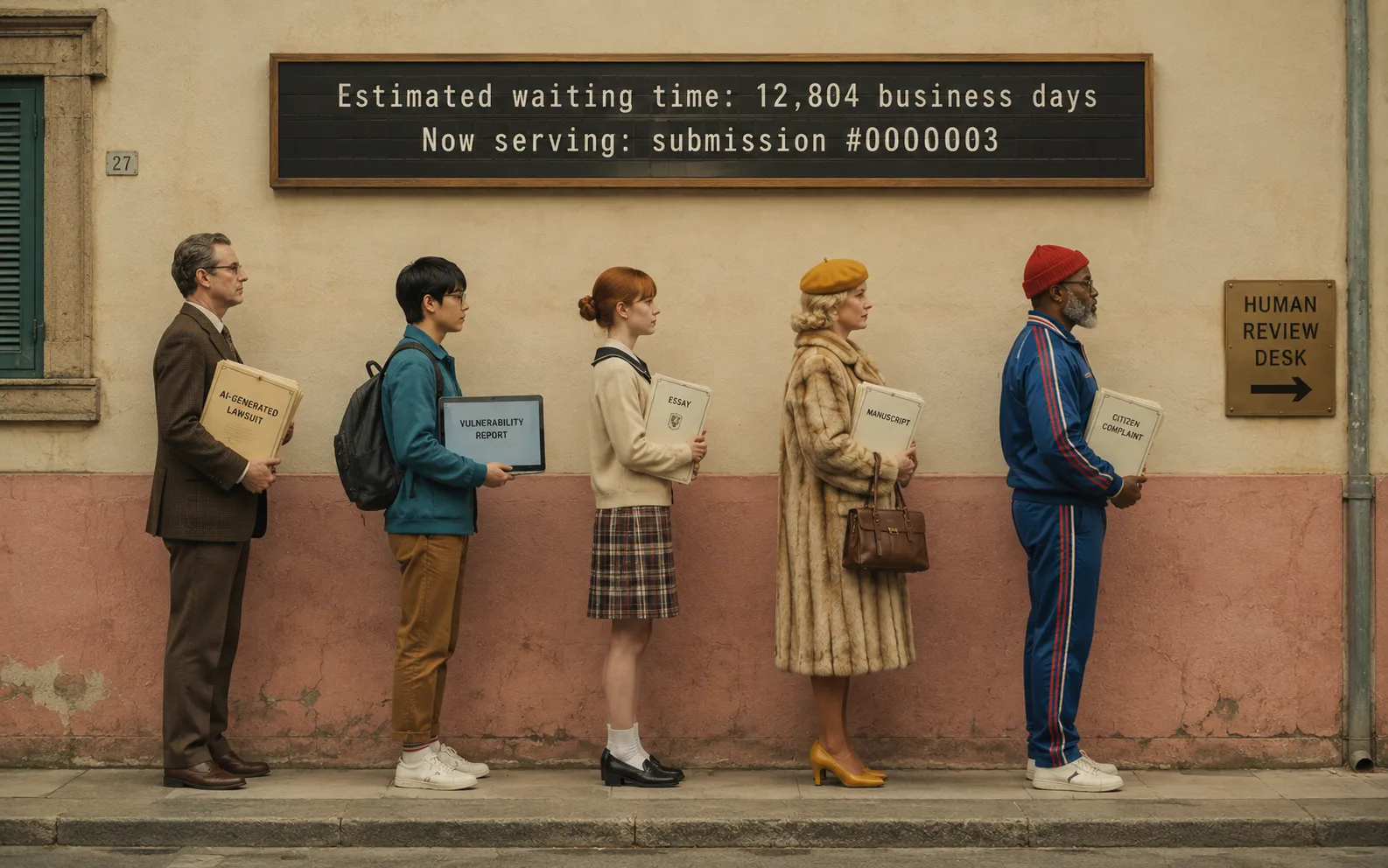
Some technologies announce themselves by solving a problem. Others announce themselves by making the old problem reproduce.
Generative AI belongs, magnificently and somewhat spitefully, to the second category. It does not merely answer questions, write code, draft letters, summarize policy documents, explain tax law, generate recipes, compose apologies, produce haiku, or pretend to understand your spreadsheet. It also manufactures volume. Not necessarily value. Volume.
Courts are now discovering this in the most formal possible way: with numbered paragraphs, jurisdictional claims, invented precedents, and a plaintiff who has clearly asked a chatbot to “make this sound more legal.” The result is not always nonsense. That is precisely the problem. Pure nonsense is easy to dismiss. Plausible nonsense is expensive.
The interesting thing about AI-generated lawsuits is that they are not just a story about hallucinated cases and lawyers being publicly spanked by judges, although that part does have the grim entertainment value of watching a magician pull the wrong rabbit out of the wrong jurisdiction. The deeper story is economic. For most of history, filing a lawsuit required either money, stamina, knowledge, or a sufficiently furious uncle who once worked in insurance. Now it also requires a prompt.
That changes the shape of access to justice. Some people who genuinely could not afford legal help can now prepare documents that at least pass the clerk’s first glance. That is not trivial. Civil law has long had a democratic defect: if you are poor, your rights may exist mainly as a decorative feature of the constitution. AI can make the front door of the courthouse less heavy.
But a courthouse is not a suggestion box. When a thousand people discover that they can generate a motion in twelve seconds, the judge cannot generate twelve extra hours in response. Legal systems were designed around scarcity: scarcity of trained lawyers, scarcity of filings, scarcity of formal language. AI attacks scarcity with the moral confidence of a photocopier left unattended in a monastery.
Software maintainers know the feeling. Open source projects have spent years begging people to file clear bug reports. Then AI arrived and, in a spectacular act of malicious compliance, produced clear bug reports by the truckload. Some are garbage. Some are duplicates. Some are real. Some are almost real, which is worse, because “almost real” must be investigated by someone who wanted to spend Saturday fixing an allocator, not adjudicating the inner life of a vulnerability scanner.
This is where the comedy becomes institutional. A human submits one sloppy report and is ignored. Ten humans submit ten sloppy reports and someone writes a CONTRIBUTING.md. Ten thousand humans with AI submit reports that are fluent, formatted, and wrong in ways that require expertise to detect. The maintainers then invent new rituals: verified reproducers, stricter disclosure rules, public submission requirements, no bounty for vague panic, please stop pasting the oracle’s burp into our issue tracker.
The Linux kernel community, with its usual tenderness, has been especially clear on this point. The problem is not that AI finds bugs. Finding bugs is good. The problem is that AI enables people to outsource discovery while keeping the social reward for themselves and pushing the verification cost onto maintainers. In other words: congratulations, you automated the fun part and donated the drudgery.
This is not limited to law or software. Academia is getting AI-generated references. Customer-support departments are getting AI-polished complaints. Public-comment portals are getting machine-expanded outrage. Editors are getting submissions that read as if a committee of scented candles had been asked to discuss geopolitics. Teachers are getting essays that are grammatically immaculate and spiritually absent. Recruiters are getting applications from people who are, apparently, all “deeply passionate about cross-functional impact.” Dating apps are getting flirtation at industrial scale, which may be the darkest timeline because even rejection now requires moderation.
The pattern is always the same: AI lowers the cost of producing a formally acceptable unit of participation. A lawsuit. A bug report. A pull request. A manuscript. A grant proposal. A complaint. A review. A comment. A job application. A love letter. A denunciation. The receiving system then has to decide whether that unit is meaningful, fraudulent, mistaken, duplicative, or merely overconfident.
We used to worry that AI would replace experts. In practice, it first replaces the shame threshold.
Before AI, many people did not submit a legal motion, vulnerability disclosure, or academic article because they knew they could not write one. Now they can write one. Or rather, something can write one for them. The resulting document has headings, citations, passive voice, and that special bureaucratic perfume of authority. It looks like the kind of thing an institution must take seriously. That is the genius and the menace of the technology: it manufactures the surface area of seriousness.
Stakeholders, naturally, are not amused. Judges did not become judges to perform CAPTCHA for fake precedent. Maintainers did not donate decades to free software so that a stranger with a leaderboard addiction could paste “potential use-after-free” into their inbox. Editors did not choose the contemplative life of rejecting prose so they could build anti-slop fortifications around peer review. Even Linus Torvalds, a man not historically famous for underreacting, has been dragged into the new etiquette of AI-assisted security reports: if the machine found it, you still have to understand it.
There is a moral lesson here, but it is not the fashionable one. The lesson is not “AI bad.” That is too easy, and also false. AI is useful. It helps people articulate claims. It finds real bugs. It drafts first versions. It summarizes tedious material. It gives the unrepresented, the understaffed, and the underfunded a tool they did not have before.
The lesson is that institutions cannot survive if submission becomes cheap while review remains expensive.
This is the real asymmetry. A chatbot can generate a ten-page complaint faster than a judge can read page two. A scanner can produce a vulnerability report faster than a maintainer can reproduce the environment. A student can create five polished essays faster than a teacher can identify the one sentence that proves nobody was home. The world has gained a miraculous engine for producing “items requiring attention.” Unfortunately, attention is the one thing it does not produce.
So the next phase of AI adoption will not be about generation. Generation is solved, in the same sense that a broken dam solves irrigation. The next phase will be about intake, triage, responsibility, provenance, rate limits, verification, and politely telling the machine-assisted public that no, volume is not evidence.
Courts will require certifications. Open source projects will demand reproducers. Journals may require source deposits. Platforms will add friction. Communities will invent norms. Somewhere, a committee will produce a 74-page policy on “Responsible Automated Participation,” and everyone will pretend to have read it.
And yet the complaint printer will continue humming.
Because AI did not create the human desire to be heard, credited, compensated, vindicated, published, promoted, or proven right. It merely gave that desire a formatting engine.
The old internet gave everyone a voice. The new internet gives everyone a paralegal, a junior security researcher, a ghostwriter, a lobbyist, and a slightly deranged intern who never sleeps.
The stakeholders are correct to be annoyed. But annoyance is not a strategy. The flood is not coming because people suddenly became more thoughtful. It is coming because thought now has a “generate” button.
The institutions that survive will be those that learn to ask, before anything else: who verified this, who is responsible for it, and why should a human spend time on it?
Everything else is just more paperwork.



No comments yet