Apple’s lawsuit against OpenAI looks, at first glance, like an argument over who left Cupertino carrying which laptop. Its larger significance is stranger. It asks what OpenAI actually owns—and therefore what investors would be buying in a possible trillion-dollar IPO. The answer is not “nothing,” but it is surprisingly close to “nothing you could drop on your foot.”
OpenAI owns model weights, software, research, patents, a powerful brand, customer relationships and the organisational recipes required to turn enormous quantities of electricity into plausible conversation. It owns ChatGPT’s distribution and has acquired a hardware team around Jony Ive. Most importantly, it owns contracts giving it access to scarce computing capacity. But the machines themselves frequently belong to Microsoft, Oracle, CoreWeave or other partners. The chips come from Nvidia and other semiconductor suppliers. Utilities generate the electricity; investors provide the capital; landlords and infrastructure companies supply the sites. OpenAI itself describes its infrastructure strategy as deliberately “partner-centric.”
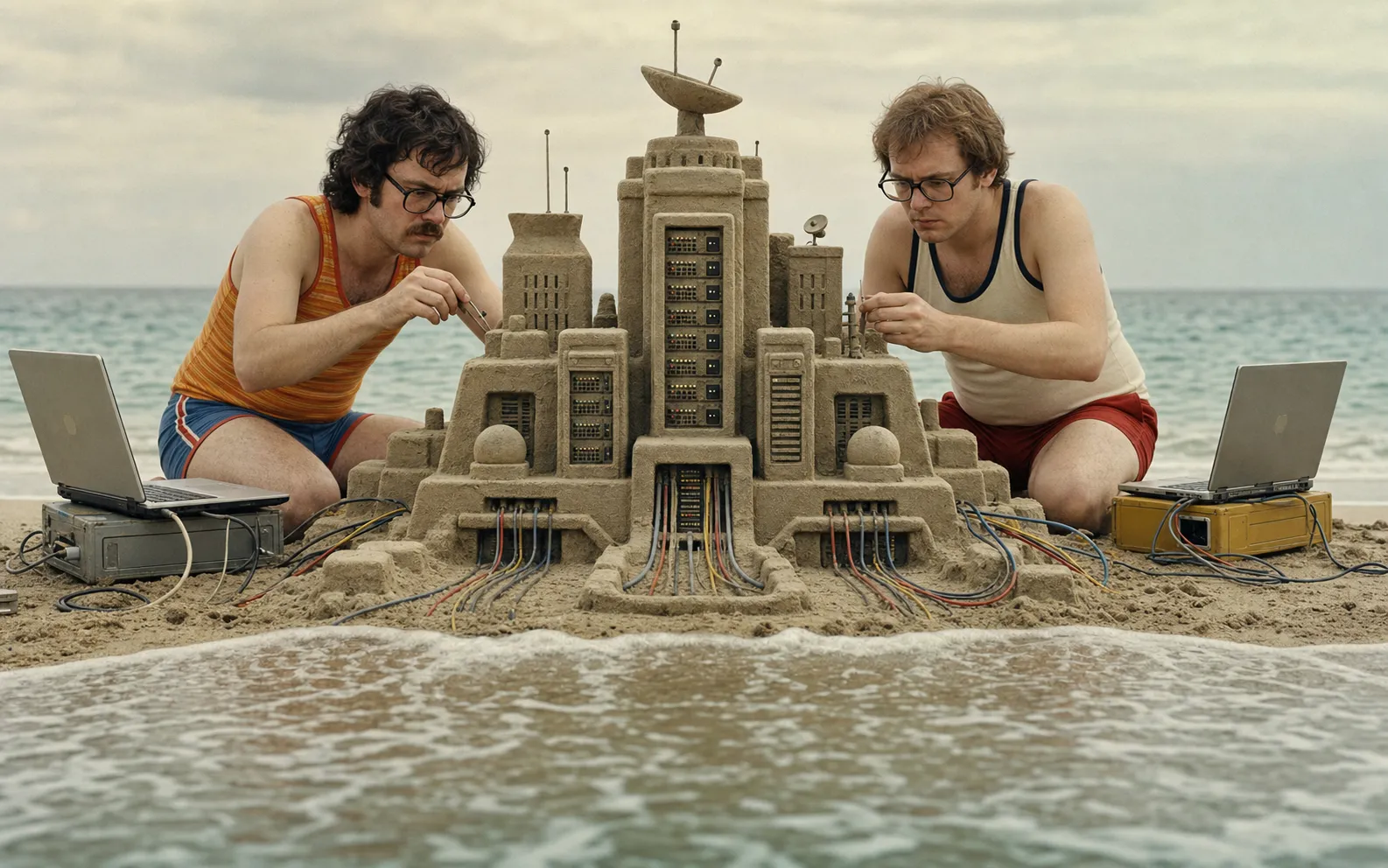
This makes OpenAI something unprecedented: an aspiring industrial giant that resembles a very clever tenant. It wants to be valued like the owner of the next computing platform while renting much of the machinery beneath it. Stargate sounds like a galactic empire, but it is largely an architecture of partnerships involving Oracle, SoftBank, CoreWeave, Microsoft and governments. OpenAI controls the blueprint and consumes the output; other parties pour the concrete, install the chips and negotiate with the electricity grid.
That arrangement is not “asset-light” in the cheerful way that a software company is asset-light. OpenAI may avoid owning every data centre, but it cannot avoid their economics. Long-term capacity agreements can behave like invisible factories on the balance sheet: the supplier owns the building, while the customer carries much of the demand risk through commitments and minimum payments. If AI margins disappoint, Nvidia can sell chips elsewhere and a utility still owns a power plant. OpenAI is left with a very expensive reservation.
Its truly proprietary assets are therefore unusually perishable. A data centre may remain useful for decades. A rocket can launch hundreds of satellites. A model that leads the benchmarks in July may be regarded as an embarrassing relative by Christmas. Model weights depreciate at internet speed. Customer loyalty is shallow because users can change chatbots more easily than banks. Even the company’s research advantage walks around wearing employee badges and updating LinkedIn profiles.
This is where Apple’s lawsuit becomes more dangerous than its probable financial damages. Apple alleges that OpenAI’s hardware leadership solicited confidential information, components and details about unreleased products from current or departing Apple employees. OpenAI denies any interest in competitors’ trade secrets, and the allegations remain unproven. But Apple is attacking precisely the narrow layer of assets that OpenAI can call entirely its own: human knowledge, intellectual property and the legitimacy of its product-development process.
If a court concludes that part of OpenAI’s hardware expertise was improperly imported, there is no reassuring warehouse full of alternative value behind it. An injunction could quarantine engineers, invalidate design work or require a clean-room reconstruction. Even without one, IPO underwriters must investigate whether the hardware division represents an asset, a liability or an expensively assembled group of witnesses. The SEC requires an offering document to disclose material risks, management issues and legal proceedings without becoming misleading. Explaining all that while keeping the device secret will be an entertaining exercise in legal origami.
Anthropic is hardly in a more comfortable position. Its valuable property is Claude, its research organisation, safety reputation, enterprise relationships and developer ecosystem. Its primary cloud and training partner is AWS; Amazon has invested billions, while Anthropic works closely with Amazon’s Trainium chip teams. It has now secured up to five gigawatts of additional Amazon capacity and also distributes Claude through Google Cloud and Microsoft Azure. Most amusingly, Anthropic has agreed to obtain compute from SpaceXAI’s Colossus infrastructure—meaning one leading AI laboratory may rent part of another competitor’s machine room. Diversification reduces the danger of dependence on a single landlord. It does not turn the tenant into a property owner.
Google plays a different game. Alphabet owns or controls data-centre land, buildings, servers, network equipment, a global fibre network and a decade of custom-TPU expertise. It also owns Chrome, Android, Search, YouTube, Workspace and the advertising machinery capable of financing the entire adventure. Alphabet spent $91.4 billion on capital expenditure in 2025 and expects $175–185 billion in 2026, primarily for technical infrastructure. Gemini can disappoint and Google still possesses the roads, shops, power tools and tollbooths.
SpaceXAI is another vertically integrated counterexample. Following SpaceX’s 2026 acquisition of xAI, the combined group contains rockets, launch facilities, Starlink satellites, the X social network and the Colossus computing complexes. It remains dependent on outside chips and terrestrial energy, but it owns considerably more of the physical stack—and can earn money launching satellites even if Grok develops a headache. OpenAI and Anthropic have fewer such shock absorbers.
This suggests a more interesting interpretation of Apple’s purpose. Apple is not merely protecting secrets; it is challenging OpenAI’s title deed to the hardware future before public investors can value it. If Apple can make that future look borrowed, legally contaminated or operationally delayed, Wall Street may value OpenAI as a renter of intelligence rather than the owner of a new platform.
The central IPO question is therefore not whether OpenAI possesses assets. It does. The question is whether those assets are durable, defensible and genuinely controlled by OpenAI—or whether they are rented computers, rented electricity and brilliant people who can take the lift downstairs. Apple has chosen to sue at the exact point where the building’s most celebrated tenant is asking the public to buy the penthouse.


No comments yet