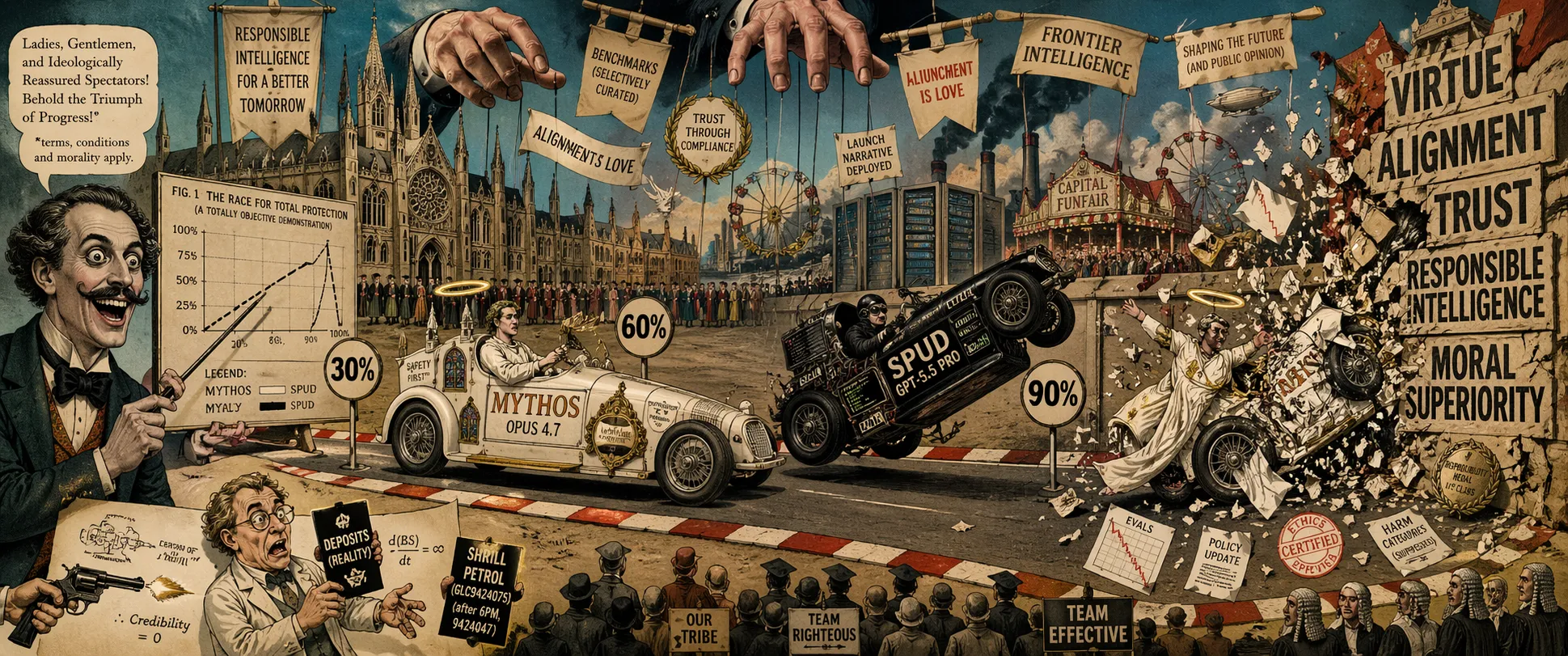
The next miracle additive has arrived. Anthropic has Opus 4.7 and Mythos. OpenAI, if the leak-industrial complex is to be believed, has GPT-5.5 Pro, codenamed Spud, allegedly polishing GPT-5 into something even more precise, more continuous, more technical, more useful, more everything. One lab offers transcendence with a safety memo attached. The other offers relentless competence with the vulgar smell of scale, money, and ambition. Both are sold with the same promise every era of technology eventually invents for itself: this time the machine is not merely better, but morally meaningful.
Which brings us, naturally, to Monty Python.
Two cars race toward a finish line while a grave voice assures the audience that one toothpaste contains the future. One car is the good car. The other is the bad car. The demonstration is absurd, the conclusion is rigged, and the audience still nods along because the point was never to discover the truth. The point was to flatter the tribe. The current LLM wars work in exactly the same way. Very little of the argument is really about model quality. Most of it is a morality play for people who want their software to validate their politics.
Who will win? The white car, or the not-white car?
Listen to the discourse long enough and the answer becomes obvious. The “better” model is usually the one used by the correct sort of person. The benchmark charts are secondary. The policy documents are decorative. The carefully staged demos are part of the incense. What really matters is cultural alignment. Which lab flatters your sense of self. Which one lets you feel clever without feeling compromised. Which one lets you keep using elite technology while still imagining that you stand on the side of virtue.
Anthropic has become, for a certain class of user, the cathedral vendor of AI. It does not merely sell capability. It sells absolution. Here is intelligence, but responsible. Powerful, but chaperoned. Ambitious, but phrased in the language of duty, caution, and ethical stewardship. It offers frontier technology to people who dislike the smell of frontier energy. That is a very profitable emotional niche. It reassures the educated conscience that one may enjoy enormous computational power without having to fraternize with the morally vulgar. The model is not just useful. It is respectable.
OpenAI, by contrast, is cast in many of the same circles as the company of bad vibes. Too commercial. Too broad. Too close to the wrong entrepreneurs, the wrong energy, the wrong instincts. Too willing to ship. Too willing to be used by ordinary people who are not properly house-trained by elite discourse. That image is simplistic to the point of parody, but parody is the natural language of partisan technology culture. Subtlety ruins the ritual. The tribe needs its saints and its sinners.
On the other side, of course, the roles reverse. OpenAI becomes the builder’s champion, the practical tool for people who want results rather than sermons. Anthropic becomes the preferred toy of the regulation class, the priesthood of cautious prestige, the company for people who enjoy typing into a chatbot only after being assured by a policy team that history will judge them kindly. Each side thinks it is arguing about intelligence. In reality, each side is consuming a brand of political self-recognition.
This is what makes the whole spectacle so dreary. Not the existence of competition. Competition is healthy. Not even the hype. Hype is inevitable. What is dreary is the sheer dishonesty of the commentary. The public conversation pretends to be about technical merit while constantly smuggling in social signaling. People do not just want the best tool. They want the best tool for someone like them. Better still, they want a tool that turns their existing ideological preferences into a story about moral superiority.
And so the companies become stand-ins for cultural factions. Anthropic is adopted by people who want to believe that intelligence belongs under enlightened supervision. OpenAI is adopted, or denounced, as a symbol of the rougher, more entrepreneurial, less apologetic world beyond the seminar room. The details barely matter. Once a product becomes a tribal marker, even its defects become virtues. Safety theater becomes proof of maturity. Commercial aggression becomes proof of realism. Constraint becomes wisdom. Reach becomes courage. The machine is no longer judged by what it does. It is judged by whom it flatters.
The truly irritating part is that the real world is less glamorous and more humiliating than the tribes would like. For a great deal of practical work, the decisive factor is not the logo on the model card. It is the human using it. A disciplined person with a merely excellent model will routinely outperform a sloppy ideologue armed with the latest sanctified wonder-machine. Prompt design matters. Task decomposition matters. Verification matters. Domain knowledge matters. Workflow design matters. Taste matters. Most of the public noise exists to conceal that deeply embarrassing fact.
It is much more comforting to believe that success resides in the moral purity of your chosen vendor. That way, when the output shines, the model confirms your worldview. And when it fails, you can blame the other tribe, the hostile benchmarks, the contaminated training data, the censorious filters, the reckless deployment culture, or whatever else fits the mood. Anything but the possibility that the problem sits between keyboard and chair.
This is why every new release now arrives dressed as revelation. Mythos. Spud. Opus. Pro. Preview. Reasoning. Agency. Continuity. Alignment. The industry has discovered that people no longer buy software as software. They buy it as a myth about themselves. Are you the refined custodian of responsible progress, or the unsentimental builder who gets things done? Are you with the good people, or the effective people? And can you please pretend those are mutually exclusive categories, because otherwise the marketing department loses its magic?
None of this means the models are identical. They are not. Some are better at coding. Some are better at long-context synthesis. Some are more stable, more cautious, more imaginative, more brittle, more irritating. Those differences matter. But they are not the reason the discourse has become so feverish. The fever comes from politics. It comes from class taste. It comes from the same exhausted human impulse to turn tools into badges and product choices into liturgy.
So who wins? The white car or the not-white car?
In the sketch, the joke is that the race was fraudulent from the beginning. The demonstration is not meant to illuminate reality. It is meant to manipulate the audience. That is where we are now. The model wars are not just contests of capability. They are stage-managed rituals in which the audience projects its anxieties, loyalties, and prejudices onto statistical engines and then calls the result insight.
The serious user should refuse the invitation. Use the best instrument for the task. Test it. Break it. Compare it. Verify it. Laugh at the slogans. Ignore the incense.
And above all, never mistake a toothpaste commercial for philosophy.

No comments yet