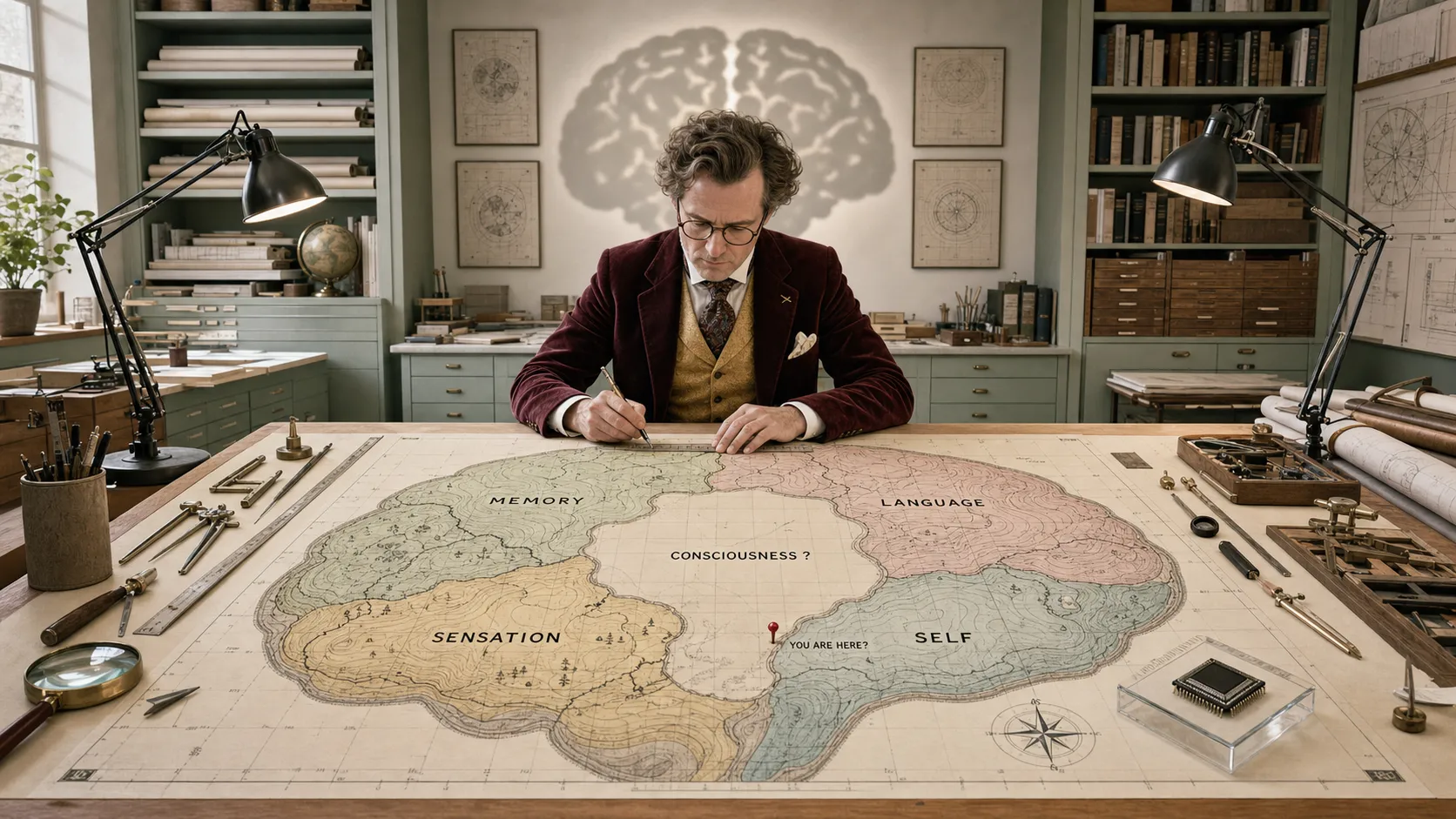
A Google employee has written a provocative philosophy paper. That is already less apocalyptic than “Google proves AI will never be conscious.” Alexander Lerchner’s paper carries an explicit disclaimer that its conclusions are his own, not Google DeepMind’s official position. It concedes that an artificial system could in principle be conscious because of its physical constitution. The viral version quietly replaces this qualified claim with a metaphysical death certificate for every possible machine.
Lerchner’s real argument deserves better. Computation, he says, is not written into silicon by nature. A chip contains voltages, currents and thermal activity; humans interpret physical states as zeros and ones, and map them onto algorithms. Computation is therefore “mapmaker-dependent.” Since an abstract description cannot produce concrete qualities—a weather simulation does not make anyone wet—an algorithm cannot instantiate subjective experience. It can only simulate the behavior of something conscious.
This is a serious objection to the laziest form of computationalism: add parameters, stir, and wait for qualia. But the argument’s move is an equivocation. It slides from “an abstract computation is a description” to “a physical system implementing that computation has no relevant intrinsic causal organization.” The first statement is trivial. The second is precisely what must be proved.
No serious functionalist believes that a mathematical object, floating in Plato’s cloud storage, feels lonely. The claim is that a physical system may instantiate consciousness by realizing the right causal organization. Software without hardware causes nothing; software running on hardware is a pattern that constrains what matter does next. The labels “0” and “1” are conventional, but the voltage-sensitive gates, feedback loops, memory states and counterfactual dependencies are not. Rename the states “turnip” and “Tuesday” and the machine will remain stubbornly causal.
The map metaphor begins to mislead. A street map does not contain traffic, but a city’s street layout—a relational pattern—does shape traffic. An architectural blueprint cannot shelter you, yet a building constructed can. Functionalism does not confuse the blueprint with the building. It asks whether the property at issue depends on the building material or on an organization that different materials can realize. Lerchner answers “material organization” but offers no independent account of which material organization produces experience.
The appeal to an external mapmaker does not settle matters either. There are respectable mechanistic theories of physical computation that identify computing systems by their organized capacities to transform physical vehicles, without requiring a human interpreter to hover over transistors. Even if computational descriptions remain partly interest-relative, observer-relativity does not imply causal unreality. “Heart,” “pump” and “systole” are human classifications; hearts move blood when no cardiologist is watching.
Worse, the argument boomerangs toward the brain. Neurons do not come factory-labeled “concept of red,” “working memory register” or “existential dread.” Brains contain electrochemical gradients, spikes, neurotransmitters and molecular commotion. Scientists partition those dynamics into meaningful states. If external description disqualifies silicon from having an intrinsic mind, it threatens our descriptions of neural computation with the same eviction notice. Lerchner needs a principled difference between the causal organization of brains and machines, not the observation that both can be described abstractly.
His simulation examples also beg the question. A simulated furnace does not heat a house because heating depends on transferring thermal energy. A simulated stomach does not digest lunch because digestion depends on particular chemical reactions. But a digital calculator does not merely simulate addition; it adds. A chess program really plays chess. Whether consciousness resembles heating, digestion, addition or something else is exactly the disputed issue. One cannot resolve it by selecting analogies whose conclusions arrive preinstalled.
This exposes the paper’s deepest circularity. Consciousness is placed on the “intrinsic” side of the ledger, while computation is defined as extrinsic symbol manipulation requiring an already conscious mapmaker. The conclusion—that computation cannot generate consciousness—then follows beautifully, much as a rabbit follows from first placing it in the hat. That is a conclusion dressed as its own evidence. What is missing is a positive theory explaining why certain thermodynamic organizations instantiate experience, which features are necessary, and why no artificial physical system could possess them. Without that theory, “content causality” risks being a handsome new label on the old explanatory gap.
None of this proves that today’s language models are conscious. Behavioral fluency is weak evidence of feeling, and caution about anthropomorphism is entirely sensible. But uncertainty cuts both ways. A major interdisciplinary report concluded that current systems are not conscious while finding no obvious technical barrier to systems satisfying several theory-derived indicators. That sober position is less tweetable than “impossible,” but philosophy is not improved by using confidence as a substitute for mechanism.
The ethical leap is therefore especially reckless. If machine consciousness is uncertain, declaring AI welfare a category error does not eliminate moral risk; it merely chooses the convenient side of it. False positives may waste concern. False negatives could license suffering at industrial scale. Sensible policy can discount speculative claims without pretending that a contested metaphysics has become a proof.
Lerchner is right that a map is not the territory. His mistake is assuming that functionalism worships the map, when its real subject is the organization of the territory. The paper punctures crude AGI mysticism, but it does not establish artificial unconsciousness. It replaces one unexplained emergence story with another, then announces that the mystery has been solved. The machine may never wake up. But this argument has not earned the right to put it to bed.



No comments yet