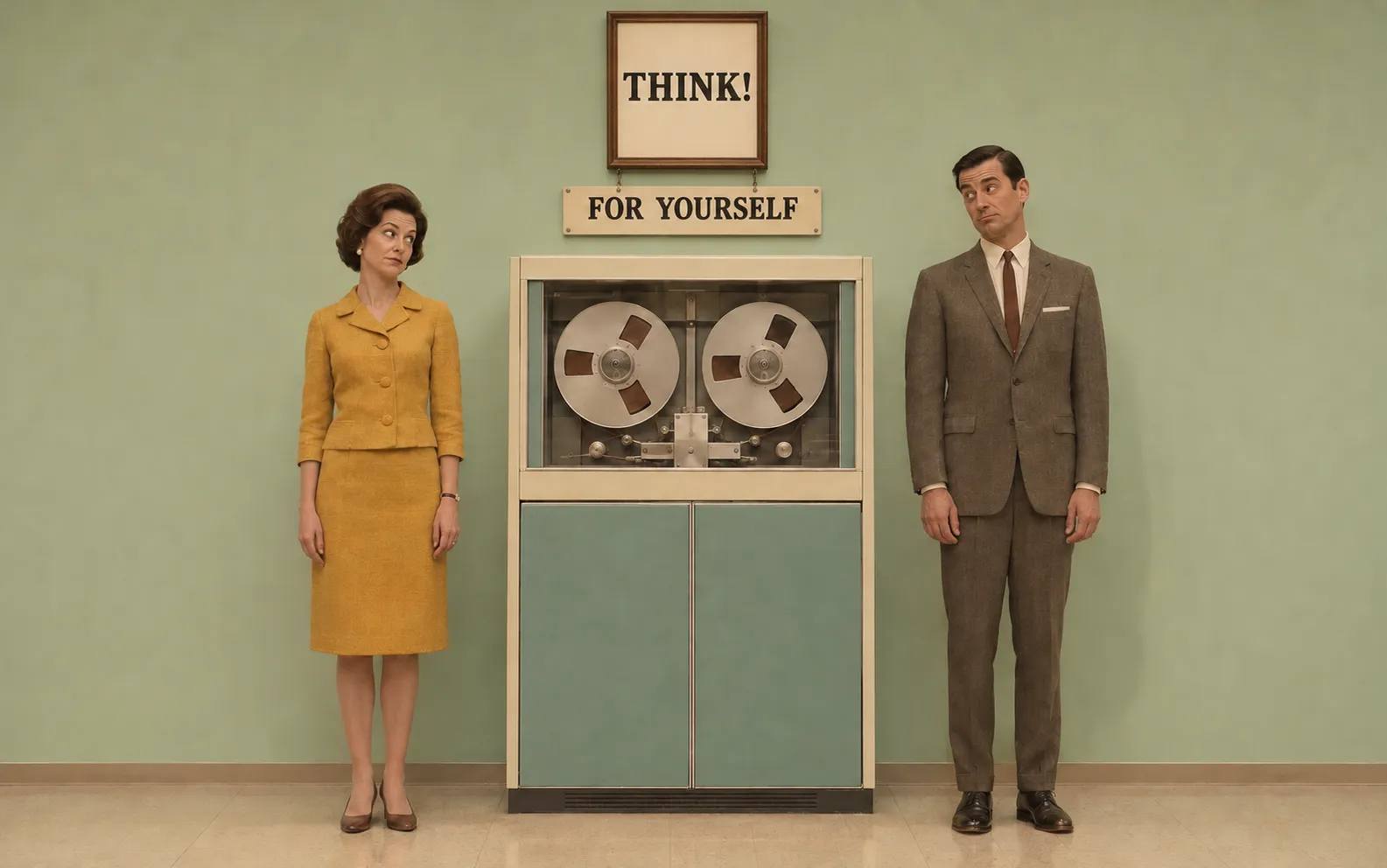
There is something wonderfully modern about an engineer helping to build machines that do your thinking, then publishing advice on how to remember to think. It resembles an escalator manufacturer issuing a pamphlet about the importance of stairs. The advice may be excellent. Your knees may genuinely need the exercise. Still, one suspects the machinery deserves a paragraph somewhere in the discussion.
Addy Osmani, who works on Claude Code at Anthropic, worries about “cognitive surrender”: the moment an AI’s answer becomes your answer without encountering much resistance from your brain. His November essay revisits an argument he published in May, expanding it into a practical guide to maintaining judgment while agents increasingly perform the work. Apparently, even warnings about outsourcing thought deserve a second deployment.
Much of his advice is sensible. Form a hypothesis before asking. Inspect evidence before accepting conclusions. Understand what a passing test actually proves. Occasionally exercise a skill without assistance. These are good habits, although their familiarity suggests we have spent extraordinary sums reinventing the teacher who asked us to show our working.
The trouble is where the essay places the burden. The tools become faster, smoother and more capable; the individual must become more vigilant, more disciplined and more deliberate. Every improvement in convenience arrives with an additional homework assignment in resisting convenience. We are promised liberation from effort, then handed a demanding personal programme for managing its disappearance.
This is not hypocrisy in any simple sense. Osmani explicitly supports agentic work, acknowledges its risks and offers ways to use it intelligently. An engineer can help build something useful while discussing its limitations. We should welcome that candour. But candour about a product’s consequences does not settle who should bear the cost of managing them.
Consider his strongest observation: verification itself can become surrender. An agent writes a feature, writes a test carrying the same mistaken assumption, runs it successfully and presents the green result. Everything agrees. Unfortunately, agreement among descendants of the same error is less reassuring than it looks. A family meeting is not an independent audit.
Osmani sees this clearly. Yet the proposed escape repeatedly returns to the user: ask what the checks missed, inspect the commands, request another review, quiz yourself. The operator must supply the independence that the apparently complete workflow lacks. The machine delivers confidence at industrial scale; the human supplies doubt by hand.
That arrangement raises a productivity question. If generating work becomes cheap while evaluating it remains expensive, what exactly have we made abundant? Useful output, certainly, but also obligations to inspect it. A thousand draft decisions are not necessarily a gift to someone with an afternoon available. Sometimes they are an unusually articulate backlog.
Osmani calls attention to this imbalance and recommends stronger checks or slowing down. Fair enough. But slowing down is a curious remedy for a technology whose attraction is acceleration. If responsible use depends on declining some of the throughput the tool enables, that restraint belongs in the design and economics of the product, not merely in the user’s character.
Imagine interfaces that made consequential assumptions prominent, separated independent evidence from generated reassurance, and exposed uncertainty before the celebratory completion message. Imagine review capacity treated as a constraint rather than an unfortunate shortage of human enthusiasm. These possibilities would not eliminate judgment. They would make exercising it less dependent on remembering an essay at six on Friday.
His allowance for rebuilding understanding on demand is more interesting still. Nobody needs to retain an entire codebase mentally; an agent can explain the relevant part when needed. That sounds reasonable. It also complicates the warning. If understanding can be reconstructed with assistance, which lost skills matter, and how do we distinguish sensible specialisation from dangerous dependence?
“Keep practising what matters” is appealing advice precisely because it postpones the difficult part: deciding what matters before circumstances reveal it. The skill that looks expendable during routine work may become essential during an unusual failure. You cannot reliably identify every emergency exit by asking which doors you used last week.
Nor does responsibility answer the competence question. Saying that a human remains accountable establishes where the consequences land. It does not establish that the human has enough time, knowledge or organisational authority to judge the output. A signature is not a cognitive upgrade. Otherwise, corporate governance would be considerably easier than it appears.
The essay’s central tension is therefore institutional. Individuals are asked to preserve the capacities that their workflows increasingly stop rewarding. An engineer who ships quickly is visibly productive. An engineer who spends an hour rebuilding understanding may be preventing a future disaster, but the disaster’s continued absence makes a rather disappointing dashboard.
Osmani deserves credit for naming the problem and resisting the cheerful fiction that polished output equals understanding. His November version adds useful nuance to May’s warning. The recycling is less troubling than the destination: another thoughtful checklist delivered to people already drowning in things to check.
The better challenge is directed at builders and employers as much as users. Make room for judgment. Pay for verification. Design systems that reveal assumptions instead of burying them beneath fluent summaries. If thinking remains indispensable, its preservation should be part of the product’s operating model, not an optional wellness routine for the customer. Useful advice is only one part of accountability.
Until then, “please think responsibly” remains a remarkably convenient warning label for the thinking industry.



No comments yet