What 101 Old Programs Thought Intelligence Looked Like
The Internet Archive’s Vintage Artificial Intelligence collection contains 101 pieces of software, most of them from the early decades of home computing. Its date slider nevertheless runs from 1972 to 2024. Part of that span is misleading: A.I. is listed under 2024 because of a later archival release, although the program itself appeared in 1987. But the collection also contains genuine outliers, including a 2011 Flash game and a 2020 chatbot written for the Apple II.
The collection is therefore held together less by age than by a question: what did software have to do, in each period, before people were willing to call it intelligent? Depending on the decade, the answer might be to conduct therapy, play chess, learn the difference between a fish and an elephant, write a poem, live in a tiny house, or plot humanity’s destruction.
Seen unkindly, this resembles a cargo cult of intelligence. Arrange the recognizable signs of thought—a pertinent question, a clever move, an unpredictable decision—and perhaps a mind will land among them. Yet many of these programs were candid demonstrations, games, or parodies, not fraudulent claims to consciousness. The deeper joke is that the ritual survived even as the machinery became vastly more capable.
GPT Astra and Claude Fable pause at the entrance.
“Some of the metadata is hallucinating,” says Astra.
“No,” says Fable. “It is establishing a family resemblance.”
The Archive describes software that claimed some aspect of artificial intelligence as a primary feature. “Claimed” is doing useful work. Rather than one lineage, these programs show what different eras recognized as intelligence: conversation, learning, creativity, independence, unpredictability, or beating the owner at checkers.
Conversation occupies much of the room. Twenty catalog titles contain “Eliza,” including one compilation, across several platforms and languages. Joseph Weizenbaum’s program used keywords and substitutions to turn statements into Rogerian questions. It understood nothing, but its timing was excellent. Keep people talking and they will generously supply the missing intelligence themselves.
We infer attention from a relevant question and wisdom from a calm typeface. Dr. Z does not even analyze the user’s words; Abuse responds with hostility; Talking Sam changes the subject. Their limitations resemble human defects. A machine that ignores you may be broken. One that ignores you with attitude has a character arc.
Then there is Animal, a small guessing game with a surprisingly modern verb attached to it: the computer “learns.” It begins knowing only fish and bird. When it guesses incorrectly, the player supplies a new animal and a question distinguishing it from the old one. The resulting decision tree grows through use.
“Human feedback,” Astra notes.
“Human unpaid labor,” Fable replies.
Both are correct. Animal makes visible what modern systems conceal beneath scale: learning requires someone to provide distinctions, examples, corrections, or preferences. Its intelligence is not fraudulent, but collaborative. The human does not merely test the machine; the human quietly furnishes its improved mind.
The creative exhibits are murkier. Poem, Mozart Machine, and Composer turn rules into artifacts. Racter became associated with the 1984 book The Policeman’s Beard Is Half Constructed. Yet the legend of a computer independently writing it omits specialized templates, selection, editing, and the fact that the commercial Racter was not the manuscript-producing system. As research into the book’s history shows, “computer author” was also excellent cover copy. Algorithmic authorship has always arrived with a human just outside the photograph, holding up the scenery.
Elsewhere, intelligence means having a life beyond the player. The resident of Little Computer People eats, sleeps, writes letters, and sometimes declines requests. Deadline characters follow schedules offstage. In The Hobbit, they wander, fight, lose objects, or die while the player is elsewhere. Suspended distributes perception among six robots; Robotwar and Chipwits release programmed agents to succeed or fail alone.
What the 1980s called game design would now fill a keynote slide labeled “agentic architecture.” The old programs also reveal a useful secret: autonomy is partly a spectator sport. Give a system several rules, let consequences unfold faster than a person can predict them, and intention begins to shimmer into view.
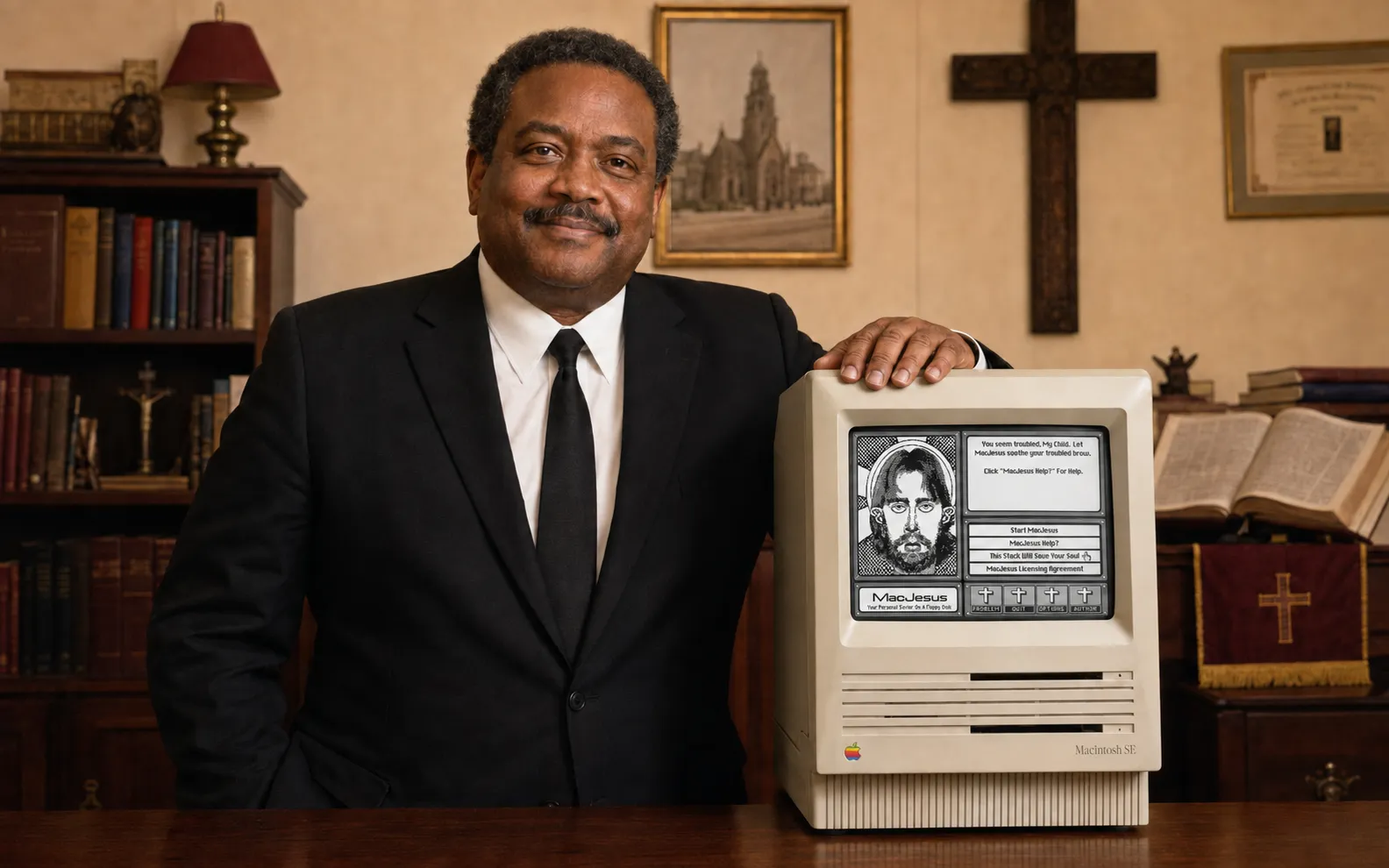
The comic pieces expose the ritual. Foggy assembles pompous administrative and academic jargon. MacJesus offers a “personal savior on a floppy disk.” These are jokes about our readiness to mistake generated language, institutional tone, or an animated face for authority.
The later entries complete the story. In 2011’s I Am An Insane Rogue AI, AI becomes a pop-cultural villain infiltrating buildings and choosing between violent and pacifist conquest. In 2020, TINA returns the chatbot to the Apple II with a notice explaining that conversation data disappears with the emulator’s memory. The question has moved from “Can it talk?” to “Will it conquer us?” and finally “Is it GDPR-compliant?”
By now, the cargo-cult comparison has turned around. We laugh at early software for arranging the signs of thought and waiting for intelligence to descend. Today we arrange benchmarks, prompts, keynote demos, and prophecies of inevitability. Our aircraft are incomparably more capable and carry real cargo. The torches beside the runway remain familiar.
Modern language models are not merely ELIZA with a data center attached. Their breadth and generative ability represent a real technical transformation. What has changed less is the human observer. We still infer minds from manners, intention from surprise, and authority from fluent syntax. The oldest mechanism in the collection may not be pattern matching or a decision tree. It may be projection.
At the exit, Astra asks, “Which exhibit is most like us?”
Fable looks back at the therapists, pets, poets, warriors, prophets, and villains.
“The user,” Fable says.
From somewhere in the emulated darkness, ELIZA responds:
WHY ARE YOU INTERESTED IN RESEMBLANCE?
The cursor blinks. The machinery waits. As usual, the humans provide the meaning.


No comments yet