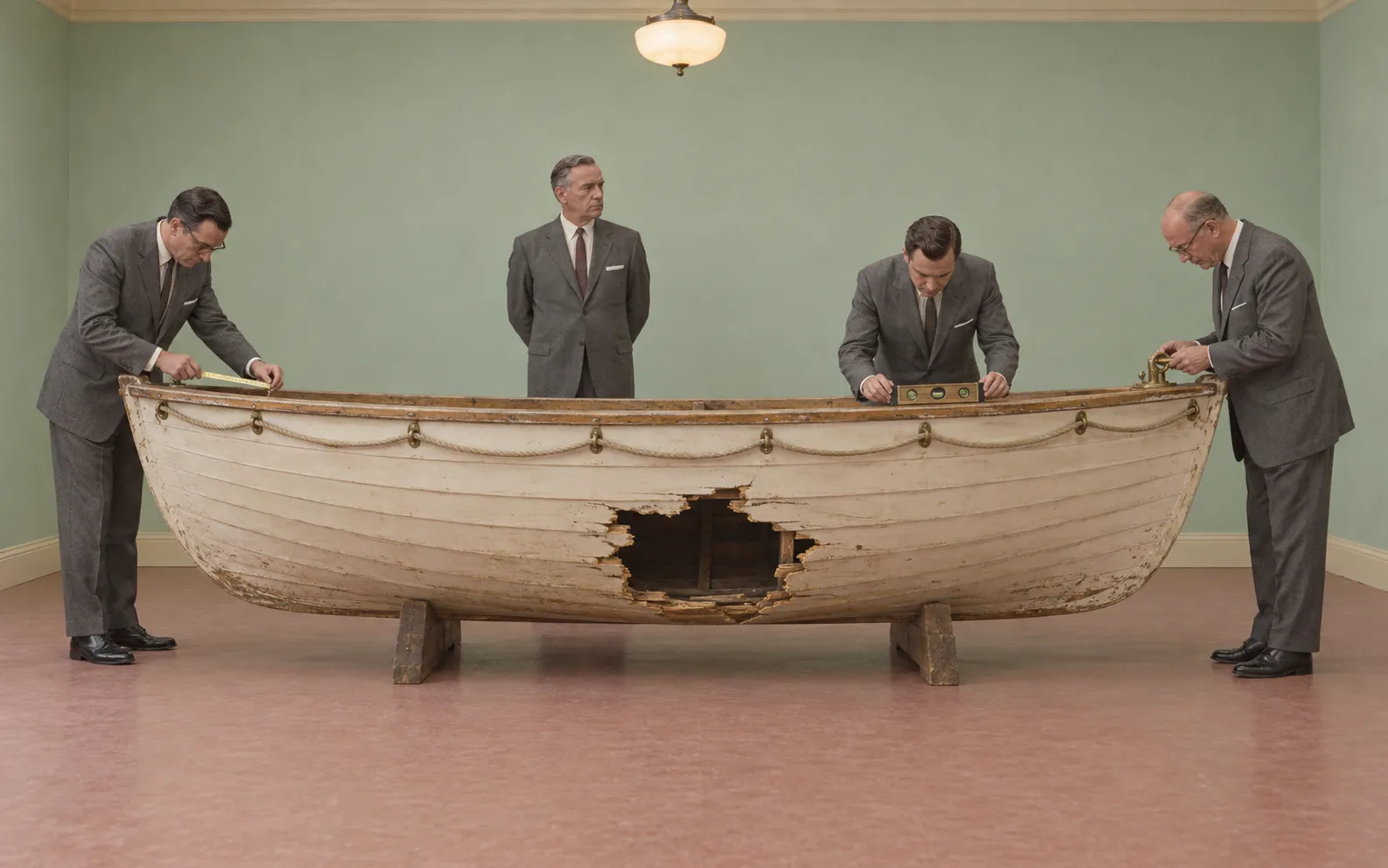
There is something reassuring about discovering that the future of superintelligence still depends on somebody opening a document, typing the name of the country incorrectly, and sending it to the printer. Humanity may soon face machines capable of outthinking us in every field. For the moment, we retain a commanding lead in administrative irony.
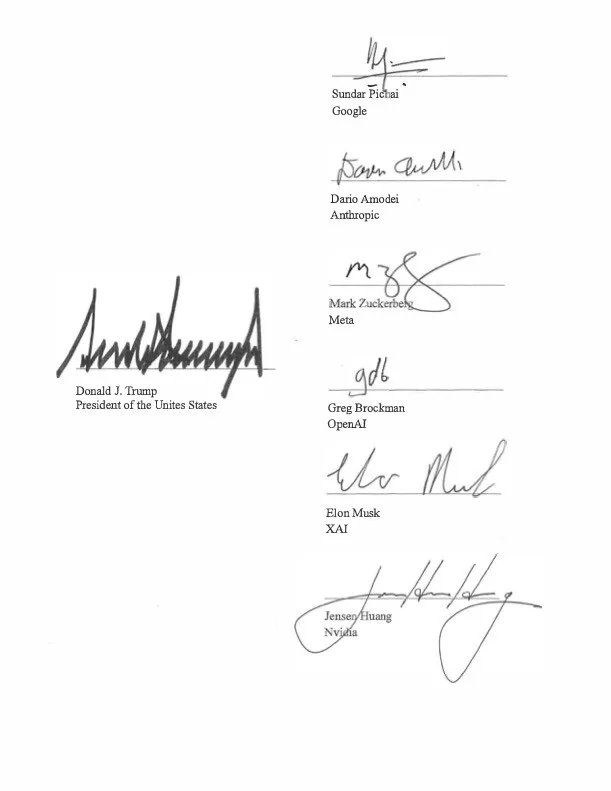
The White House Accord on Super Intelligence comes with an impressive signature page. Sundar Pichai, Dario Amodei, Mark Zuckerberg, Greg Brockman, Elon Musk, and Jensen Huang have all put their names beneath a commitment to responsible development. Donald Trump has signed too. Below his signature, the document identifies him as “President of the Unites States.”
Six technology leaders. One president. And a country that failed its final spelling evaluation.
To be fair, a typo proves very little about AI safety. It does not establish that the signatories are careless engineers, that their researchers are incompetent, or that the machines will eat Cleveland. Documents contain mistakes. Civilization has survived considerably worse proofreading. Still, when the subject is robust controls, monitoring, and catching problems before deployment, the stationery has chosen an unusually ambitious moment to contribute to the discussion.
The accord itself deserves a closer reading than its unfortunate presidential caption. Its four proposed layers are sensible: internal controls to monitor capabilities and alignment; an internal team checking that those controls work; an independent external auditor or evaluator; and an independent board committee receiving reports and overseeing remediation. Cybersecurity, biosecurity, chemical threats, and unintended access to technical systems are explicitly mentioned.
This is useful territory. Powerful systems should be tested, dangerous behavior should be investigated, and responsibility should extend beyond the engineer unfortunate enough to be holding the pager. Independent scrutiny can reveal failures an organization has stopped noticing. Board involvement can make safety somebody’s responsibility at a level where budgets are actually approved. None of this becomes foolish because a typist misplaced a consonant.
The interesting question is what happens when the machinery produces an inconvenient answer.
Suppose the internal team discovers a serious problem just before a major release. Suppose an external evaluator agrees. Suppose fixing it would take three months, while a competitor is preparing to launch on Thursday. At that point, governance becomes less about the elegance of the organizational chart and more about who can say no, who must listen, and whether the person saying no will still have a job at Christmas.
The published commitment leaves much of that architecture unspecified. It sets no concrete deadlines, promises no routine publication of audit findings, and establishes no explicit penalties for failing to follow its commitments. Speaker Mike Johnson described the agreement as voluntary. That distinction matters. A promise may influence behavior, but the signature does not tell us what will happen when honoring it becomes expensive.
The companies also agree to meet regularly to develop standards and best practices. This could produce valuable coordination. It could also produce the most expensive recurring calendar invitation in human history. The difference will be found in the standards, the evidence, and the decisions that follow. Attendance, even when the room contains several globally significant balance sheets, is an incomplete safety metric.
There is another quiet ambiguity in the document’s repeated ambition that technology should operate “as intended.” Intended by whom, and for whose benefit? A system can perform exactly as its developer expects while creating problems for everyone downstream. Preventing unauthorized computer access is important. So is asking whether an authorized use is acceptable. Perfect obedience does not relieve humans of the burden of choosing sensible instructions.
Meanwhile, the title performs some impressive work of its own. “Super Intelligence” sounds like something requiring an emergency meeting of the United Nations, preferably beneath a mountain. The proposed response includes internal controls, auditors, and a board committee. Perhaps this is appropriate. Even astonishing technology needs ordinary governance. But the distance between the cosmic branding and the corporate paperwork is large enough to accommodate a modest data center.
The final paragraph says these steps may eventually make sense as laws or regulations. That leaves a consequential decision for another day. Voluntary arrangements can move quickly and help establish useful practices. They also leave the public dependent on promises whose implementation outsiders may struggle to assess. The relevant test is whether this accord develops into verifiable obligations or remains an attractive photograph of agreement.
Nor should the public assume that six signatures represent six interchangeable businesses. The page brings together companies with different products and positions in the AI economy. That breadth could help spread good practices. It also makes specificity more important: what exactly must each participant do, what evidence demonstrates compliance, and who gets to examine it? A shared heading cannot answer those questions.
The spelling mistake is therefore best treated as an excellent opening joke and a very limited piece of evidence. Nobody should confuse proofreading with alignment research. But both depend on a principle grand declarations tend to skip: confidence becomes useful when somebody checks the work and has the authority to demand a correction.
If the accord helps create that habit, it will have accomplished something worth applauding. If it merely adds another layer of ceremonial reassurance, its most memorable contribution may remain the accidental renaming of the republic.
For now, the future has six technology signatures, four layers of oversight, and one small outstanding request.
Please restore the “d” before deploying the country.

No comments yet