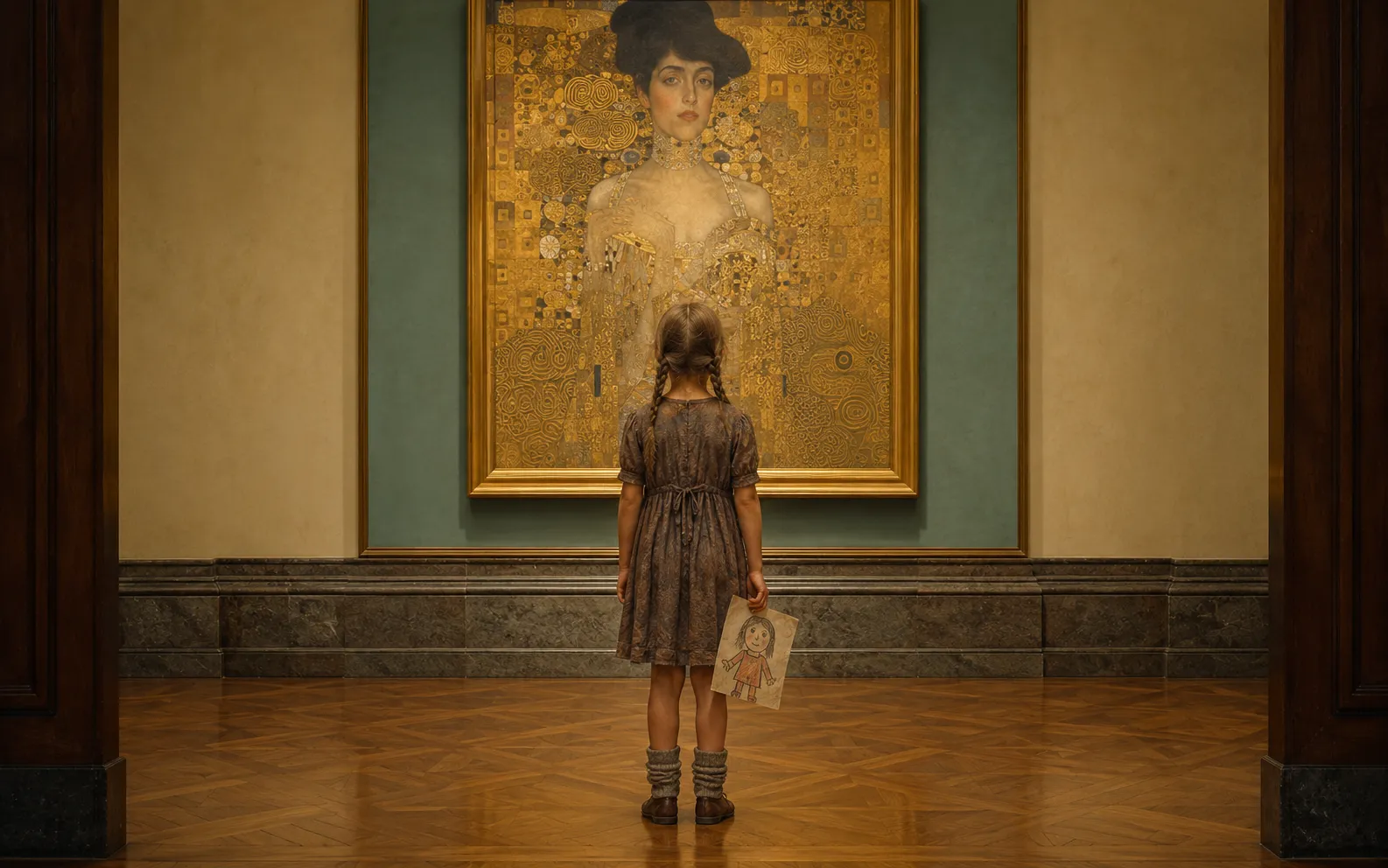
The most common fear about artificial intelligence is that it will make us intellectually lazy. We will stop thinking, stop learning, stop writing, stop solving problems, because a machine will do it faster and more cheaply. There is some truth in that fear. Tools change habits. A calculator changes arithmetic. GPS changes our sense of direction. Search engines changed memory. AI will change thinking.
But I suspect the deeper danger lies elsewhere.
The real threat is not that we will become too lazy to think. The real threat is that we will begin to believe our own thinking is no longer worth anything.
Imagine a child showing his father a drawing. The father smiles and says, “Very nice.” Then he immediately takes out another drawing, made by someone far more skilled, and places it beside the child’s work. The second drawing has better proportions, better shading, better composition. It is objectively superior. The father has not shouted. He has not insulted the child. He may even believe he has encouraged him by showing what is possible.
But the child does not experience possibility. He experiences erasure.
The lesson is not “I can improve.” The lesson is “What I made was not enough.” If this happens once, it is merely clumsy. If it happens every time, the damage becomes structural. The child no longer needs the father to produce the superior drawing. He begins to carry the comparison inside himself. Before he draws, he already sees the better drawing. Before he writes, he already hears the better sentence. Before he speaks, he already anticipates the more intelligent answer.
The external invalidation has become self-invalidation.
Artificial intelligence risks turning this private psychological mechanism into a general cultural condition. For the first time, almost every person can be confronted instantly with an output that appears more polished, more informed, more fluent, more visually impressive, or more technically correct than their own first attempt. The teenager writing a poem is no longer comparing himself with classmates or a few famous poets. He is comparing himself with a system that can imitate the accumulated surface of world literature. The student attempting a proof can summon a cleaner proof. The programmer experimenting with code can ask for a finished implementation. The designer, musician, essayist, teacher, consultant, and hobbyist all encounter the same silent question: if something better can be produced in seconds, why produce my merely human version at all?
This is not exactly impostor syndrome. The impostor fears being exposed as a fraud despite real competence. It is not exactly perfectionism either, although perfectionism is part of it. Perfectionism says: “It must be flawless before it counts.” AI-induced self-invalidation says something more corrosive: “It does not count because something better already exists.”
That sentence is poison.
Civilization has never depended on everyone producing the best possible work. It has depended on millions of people producing their own imperfect work. Every scientist begins with naive questions. Every programmer writes clumsy code. Every musician plays badly before playing well. Every writer imitates before finding a voice. Every skilled person has a long private history of mediocrity. If we destroy the dignity of the first attempt, we destroy the path to mastery.
The philosophical mistake is to confuse value with optimality. A drawing is not valuable only if it is the best drawing. A thought is not valuable only if it is the most original thought. A text is not valuable only if it could not be improved by an expert or generated more elegantly by a machine. Human acts have other forms of meaning: they express attention, effort, taste, memory, judgment, affection, resistance, curiosity, and identity. A child’s drawing matters because the child made it. A student’s proof matters because the student understood something through it. A person’s essay matters because it records the movement of a particular mind through a particular problem.
AI can produce output. It cannot take ownership of our becoming.
This distinction will become essential for education. If children grow up believing that every attempt is instantly measurable against a synthetic ideal, many will withdraw before they begin. The result will not be a generation of lazy thinkers, but a generation of prematurely defeated ones. They will know too much about what excellence looks like and too little about how excellence is reached. They will see the finished cathedral and feel ashamed of the first brick.
The answer is not to ban AI or pretend it is unimpressive. That would be dishonest and futile. The answer is to change the order of contact. Create first, consult AI second. Write the paragraph before asking for alternatives. Attempt the proof before reading the solution. Sketch the idea before generating images. Think long enough to leave fingerprints.
We also need protected spaces for practice. Not every act must be optimized, published, compared, scored, or improved. Some work should remain deliberately inefficient because inefficiency is where skill forms. A notebook, a classroom, a workshop, a rehearsal room, and a private repository should not be treated like a product pipeline. They are places where humans are allowed to be unfinished.
Parents and teachers will need a new discipline of response. When someone shows a first attempt, the first answer should not be a better example. It should be recognition. “I see what you tried to do.” “Tell me why you chose that.” “What part do you like?” “What would you change next?” Improvement can come later. Resonance must come first.
For adults, the rule is similar. We must learn to compare less against the impossible average of humanity and more against our own previous state. Did I see something more clearly? Did I formulate a thought that was mine? Did I become more capable through the attempt? These questions restore agency. They move us from ranking to growth.
AI will become a powerful companion, critic, editor, simulator, and amplifier. But it must not become the father with the better drawing, standing over every human gesture. The danger is not that machines will think. The danger is that humans will stop granting legitimacy to their own thoughts.
The existence of something better does not invalidate the existence of something personal. Better is not the same as meaningful. Faster is not the same as earned. Polished is not the same as lived.
The future will not be decided only by what AI can do. It will be decided by whether humans still dare to begin.
No comments yet