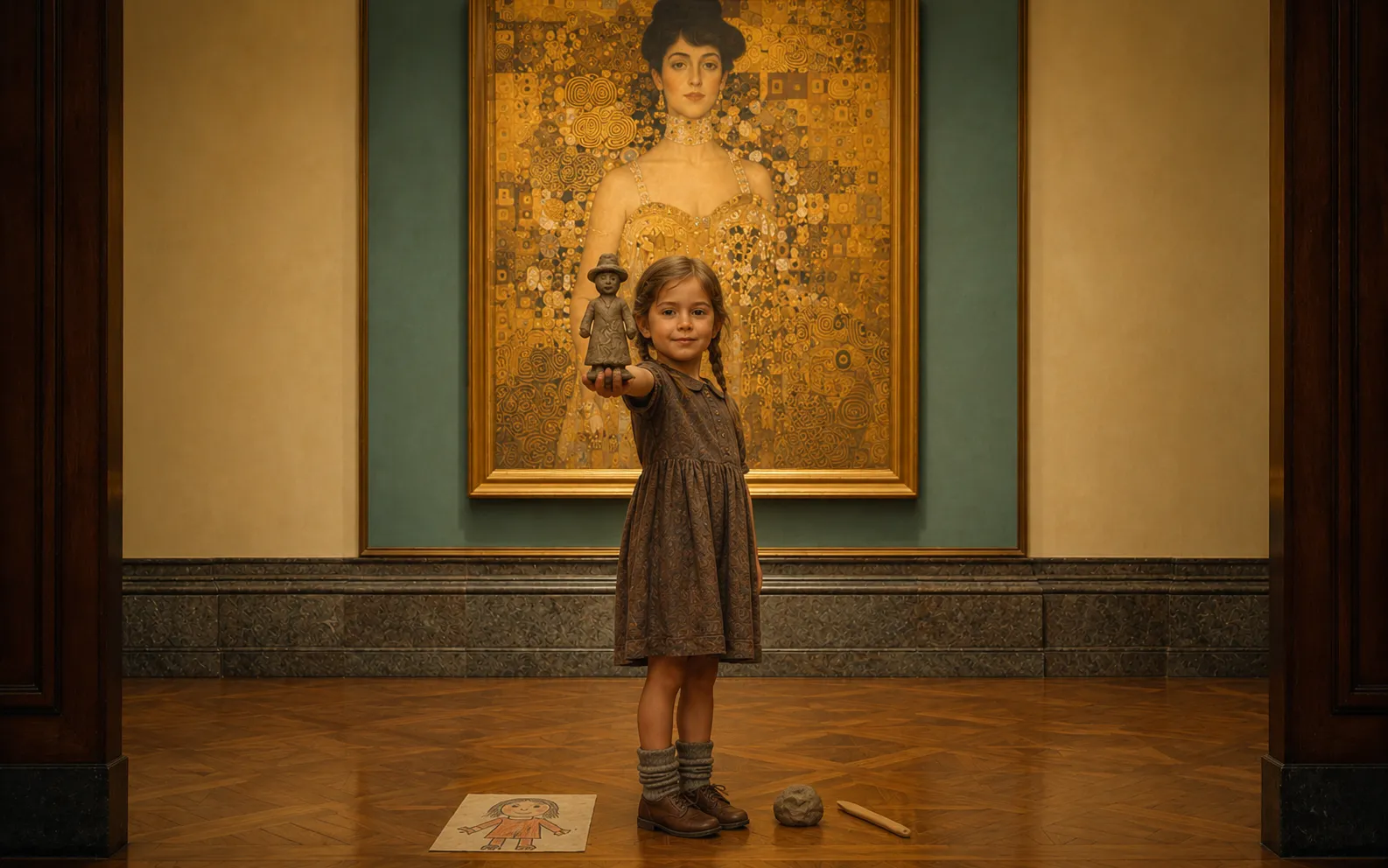
In the previous essay, I argued that the deepest psychological danger of artificial intelligence is not intellectual laziness but self-invalidation. The fear is not merely that people will stop thinking because machines can think for them. The fear is that people will stop trusting the value of their own imperfect thoughts because a machine can instantly produce something more polished.
That danger is real. But it is not the whole story.
AI is not automatically the father standing beside the child with the better drawing. It can become that figure. It can become the endless comparison machine, the cabinet of superior examples, the polished answer that arrives before the human hand has even touched the paper. But it can also become something quite different: the patient tutor, the quiet rehearsal room, the sparring partner, the editor who never sighs, the collaborator who is available when no mentor, teacher, or sympathetic peer is present.
The difference matters.
Not everyone begins with confidence. Not everyone grows up in a house where first attempts are welcomed. Not everyone has access to a good teacher, a thoughtful editor, a senior programmer, a musical collaborator, or a mathematically literate friend who can say: “Try again, but look at this part.” For many people, the first brick is not merely difficult. It is socially unavailable. They may have no one to ask, no safe place to fail, no language for what they are trying to do, and no one who can turn confusion into a next step.
For such people, AI can lower the threshold of participation.
A student who is ashamed to ask a basic question can ask it privately. A young programmer can get unstuck before frustration becomes defeat. A non-native speaker can draft in a language that once felt locked behind social embarrassment. A person with an idea for an essay can explore structure before daring to write. A child who cannot draw well may still learn to describe an image, compare versions, revise intention, and discover taste. In these cases, AI does not replace the first attempt. It makes the first attempt less lonely.
This is the other side of the problem. The same technology that can amplify comparison can also amplify iteration. It can make practice cheaper, feedback faster, and entry less humiliating. It can provide scaffolding where there was previously only silence. It can help people remain in contact with a task long enough to improve.
The danger, then, is not AI in isolation. The danger is the surrounding culture of use.
If AI is integrated into a culture of performance, it becomes a weapon of self-invalidation. If every text must be polished, every image cinematic, every post optimized, every argument sharpened, every résumé machine-improved, every classroom submission flawless, then the human draft begins to disappear. The default becomes: AI-polished or invisible.
That is a bleak future. Not because the outputs are bad. Many of them will be good. That is precisely the problem. A culture flooded with competent polish can become hostile to visible becoming. The rough sketch, the awkward paragraph, the naive question, the half-formed argument, the failed experiment, and the strange personal mark all begin to look like defects rather than evidence of life.
Social media already pushed us in this direction. It taught people to compare their private uncertainty with the public surfaces of others. AI intensifies this because the surface can now be manufactured instantly. The polished version is no longer the result of long practice, social privilege, or professional help. It is the new baseline. The danger is that ordinary human effort starts to look embarrassingly unfinished by default.
But there is another possible culture.
In that culture, AI is not used to erase fingerprints but to reveal them more clearly. It helps with grammar without flattening voice. It suggests alternatives without replacing judgment. It explains errors without humiliating the learner. It accelerates repetition without pretending that repetition is obsolete. It makes drafts more possible, not less legitimate.
The crucial distinction is between substitution and support.
Substitution says: “Do not bother. The machine can do it better.”
Support says: “Begin here. Now look again. What did you mean? What do you want to change? Which version feels more like yours?”
The first produces dependence and comparison. The second produces agency.
This distinction should guide education. Students should not merely be told whether AI is allowed or forbidden. They should be taught different modes of contact. There is a time to struggle unaided, because struggle builds internal structure. There is a time to ask for hints, because hints preserve ownership better than solutions. There is a time to request critique, because critique can sharpen perception. There is a time to use AI for polish, because polish is not morally suspect. But these are different acts. Confusing them damages learning.
A useful rule is simple: never let the tool steal the moment in which the mind first reaches for the problem.
That moment may be small. A sentence. A sketch. A hypothesis. A clumsy proof. A bad melody. A rough outline. But it matters because it establishes authorship. Once there is something human on the table, AI can become useful. Without that first gesture, it easily becomes a replacement for intention itself.
This also means that the responsibility cannot rest only on individual discipline. Telling people to “use AI wisely” is not enough if every platform rewards polished output and every institution quietly raises expectations because machine assistance is assumed. Incentives shape psychology. If rough human work is punished with invisibility, people will stop showing rough human work. If process is never valued, process will retreat into shame.
We therefore need cultural counterweights.
We need classrooms where drafts matter. We need creative spaces where unfinished work is not treated as failed work. We need professional environments that distinguish between competent automation and genuine judgment. We need platforms, journals, communities, and blogs that remain hospitable to voice, eccentricity, process, and human limitation. We need to make room for the visible seam, the awkward edge, the idiosyncratic phrase, the mark that proves a person was there.
This does not mean romanticizing incompetence. It does not mean rejecting improvement. It means refusing to confuse polish with value. A polished empty thing is still empty. A rough living thing may be worth attention.
AI will make it easier than ever to remove the roughness. Sometimes that will be useful. Sometimes it will be fatal.
The question is not whether AI helps or harms creativity. It does both. The question is whether our culture uses it to widen the entrance or raise the bar so high that fewer people dare to enter.
If we treat AI as an oracle of superior output, it will become the father with the better drawing. If we treat it as a workshop, it may help more people draw in the first place.
The future of human expression will not depend only on model capability. It will depend on the rituals we build around first attempts. Do we ask people to compete instantly with the finished cathedral? Or do we protect the dignity of the first brick?
AI can invalidate the human hand. It can also steady it.
The tool is not the father. But culture can teach it to behave like one.
No comments yet